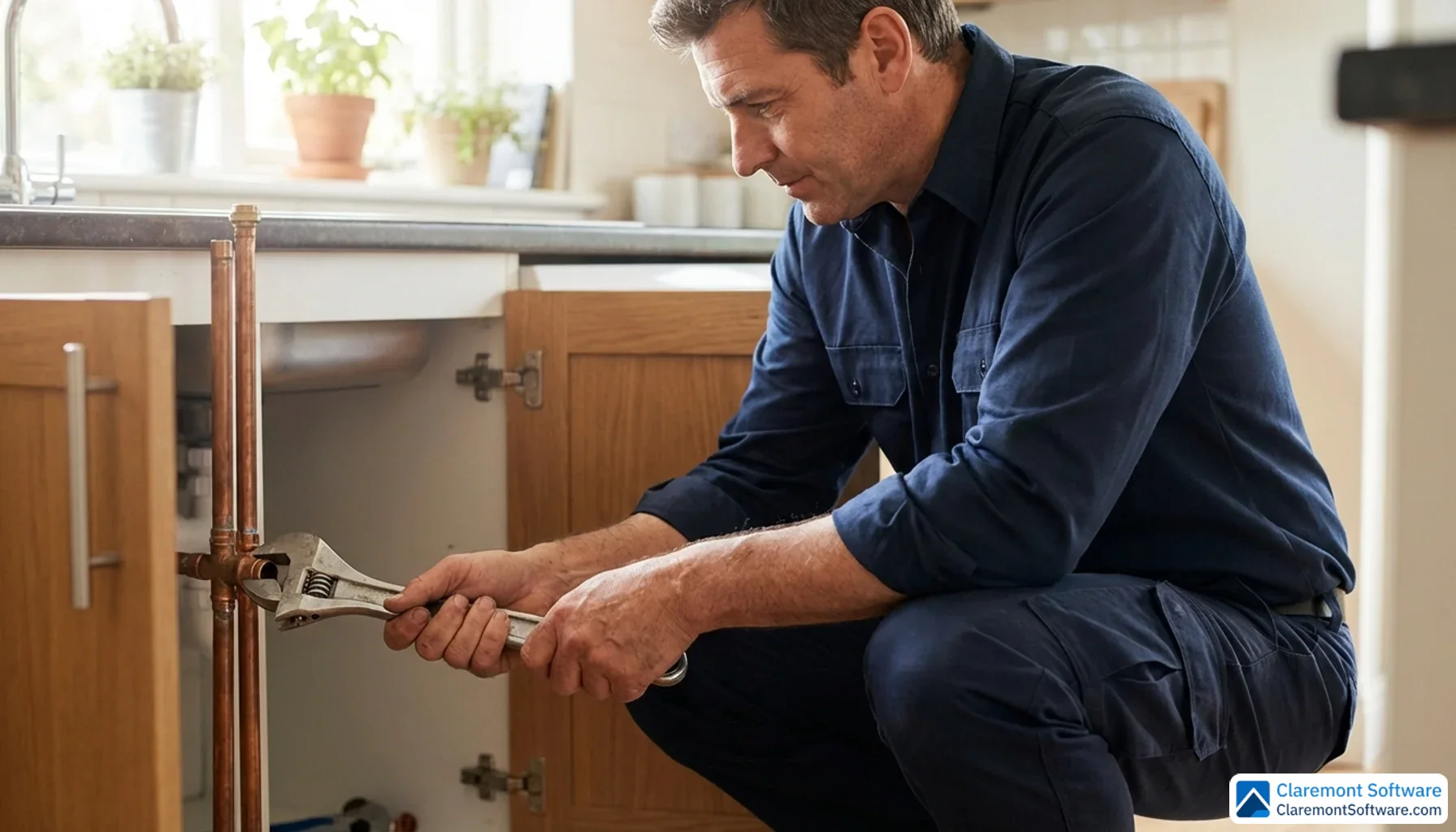
Plumber digital marketing in 2026 comes down to four channels that actually produce calls: local SEO plus your Google Business Profile (the map pack), Google Local Services Ads (pay-per-lead), a fast mobile-first website that converts visitors into callers, and a systematic review engine. Start with your GBP and website — they compound for free; add paid ads once call tracking is in place so you know your cost per lead.

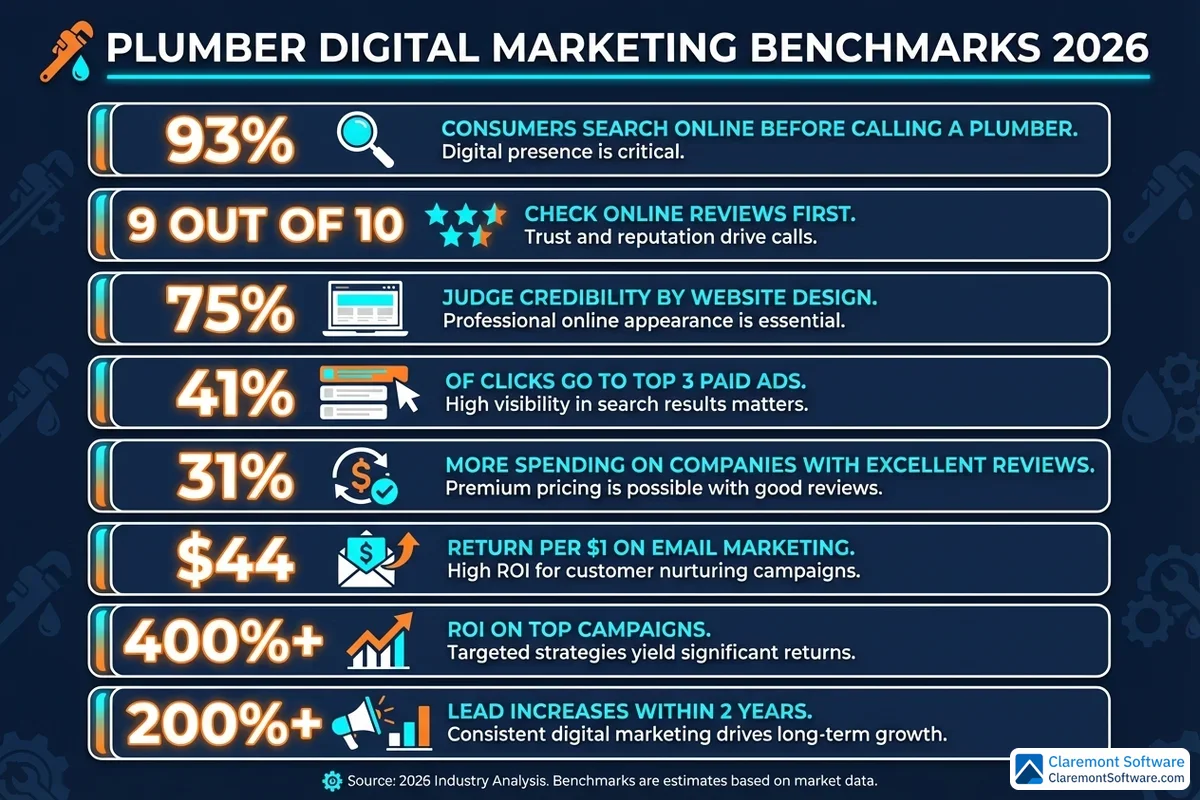
With 93% of consumers searching online before calling a plumber, your digital presence isn't just a nice-to-have — it's the lifeline of your plumbing business in 2026.
The industry has shifted permanently. Homeowners no longer flip through phone books or ask neighbors for referrals as a first step. They Google, scroll reviews, compare websites, and click ads — all before ever picking up the phone. If your plumbing business isn't showing up at every stage of that journey, you're handing jobs directly to your competitors.
This guide covers every digital marketing channel plumbers need to master in 2026, from local SEO and Google Ads to AI-powered tools and reputation management. Whether you're a solo plumber working with $500 a month or a multi-location operation investing $10,000 or more, you'll find actionable strategies tailored to your budget and growth stage.
We'll break down ROI benchmarks, channel-by-channel budget recommendations, seasonal strategies, and how to decide whether to handle marketing in-house or bring in professional help. By the end, you'll have a clear, prioritized roadmap for turning your online presence into your most powerful lead generation engine.
What Is Digital Marketing for Plumbers (And Why It Matters in 2026)
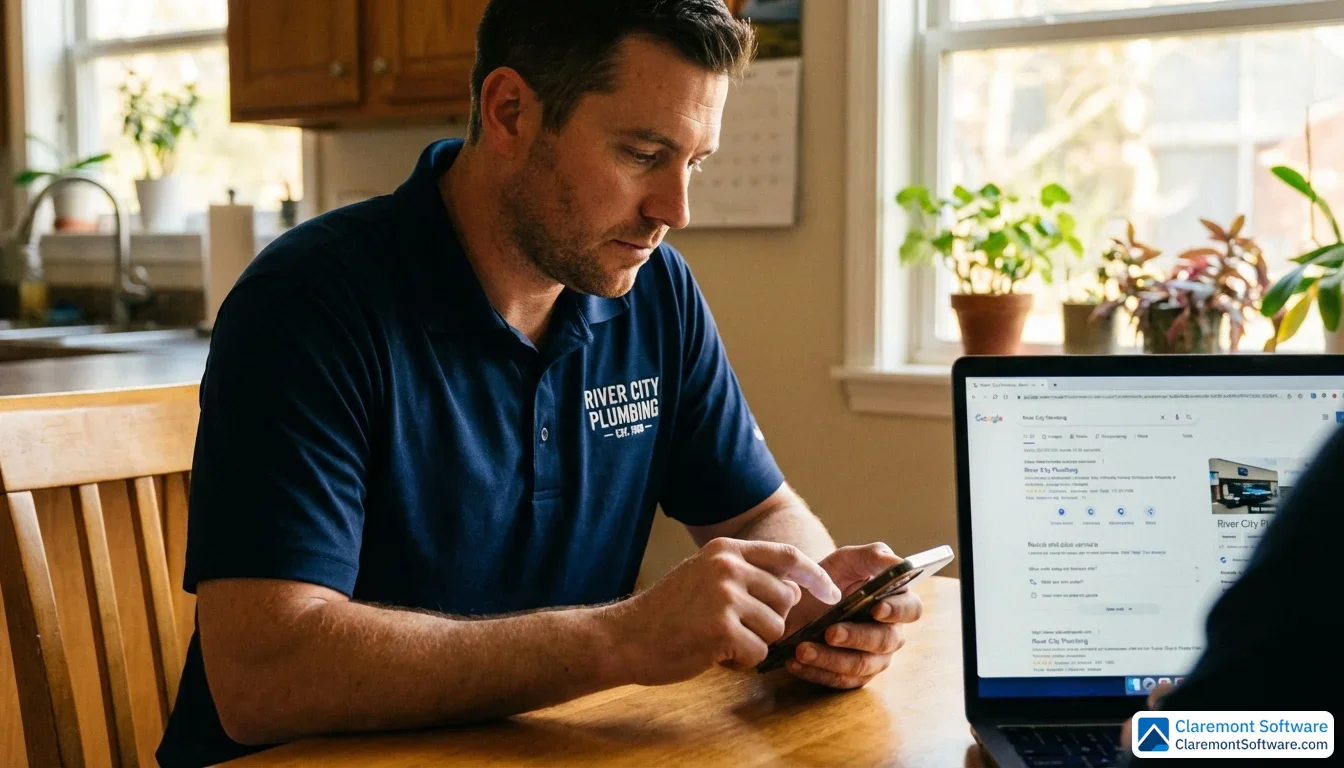
Plumber digital marketing is the umbrella term for every online strategy a plumbing business uses to attract new customers, convert website visitors into booked jobs, and keep existing customers coming back. That includes search engine optimization (SEO), pay-per-click advertising (PPC), social media marketing, email and SMS campaigns, content creation, and online reputation management. These channels don't operate in isolation — when they work together, they create a lead generation engine that runs around the clock, even when your technicians are knee-deep in a pipe repair.
(And if you'd rather have one local team run all of it for you, that's exactly what our digital marketing for plumbers program covers.)
The numbers make the case plainly: 97% of online experiences begin with a search engine, and 93% of consumers who need a plumber will search online before making a call. That means if your business isn't visible in search results, on Google Maps, or in paid ads, you're effectively invisible to the vast majority of potential customers — regardless of how good your work actually is.
This is a meaningful shift from the traditional marketing playbook. Yard signs, truck wraps, and direct mail still have their place, and a well-branded service van driving through a neighborhood isn't worthless. But these tactics are passive and difficult to measure. Digital marketing is active, targeted, and trackable — you can see exactly which campaign generated a lead, what that lead cost you, and whether it turned into a paying job. The most successful plumbing businesses in 2026 aren't choosing between traditional and digital; they're using both, with digital doing the heavy lifting.
The 2026 landscape adds new layers of complexity. Google's AI Overviews (formerly Search Generative Experience) now answer many search queries directly on the results page, reducing clicks to websites. Voice search queries like "Hey Google, find an emergency plumber near me" are phrased conversationally and require a different optimization approach. Zero-click searches and evolving privacy regulations are reshaping how plumbers get found and how their ads are targeted.
Understanding the customer journey is essential here. A homeowner with a burst pipe isn't browsing — they're searching frantically and calling the first credible result they find. A homeowner planning a bathroom remodel is researching over days or weeks. Digital marketing touches every stage of that journey: building awareness through content and social media, capturing intent through SEO and paid ads, converting visitors through a well-designed website, and retaining customers through email and review management. Each channel plays a role, and together they compound over time.
Local SEO for Plumbers: Dominating the Map Pack and Organic Results
When a homeowner's basement is flooding at 11 PM, they're not scrolling through a stack of mailers or squinting at a billboard. They're grabbing their phone and typing "emergency plumber near me" — and they're calling whoever shows up first. That's exactly why local SEO consistently delivers the highest return on investment of any digital marketing channel for plumbing companies. It puts your business directly in front of people who are actively searching for what you offer, at the precise moment they need it most.
Google Business Profile: Your Most Powerful Local Asset
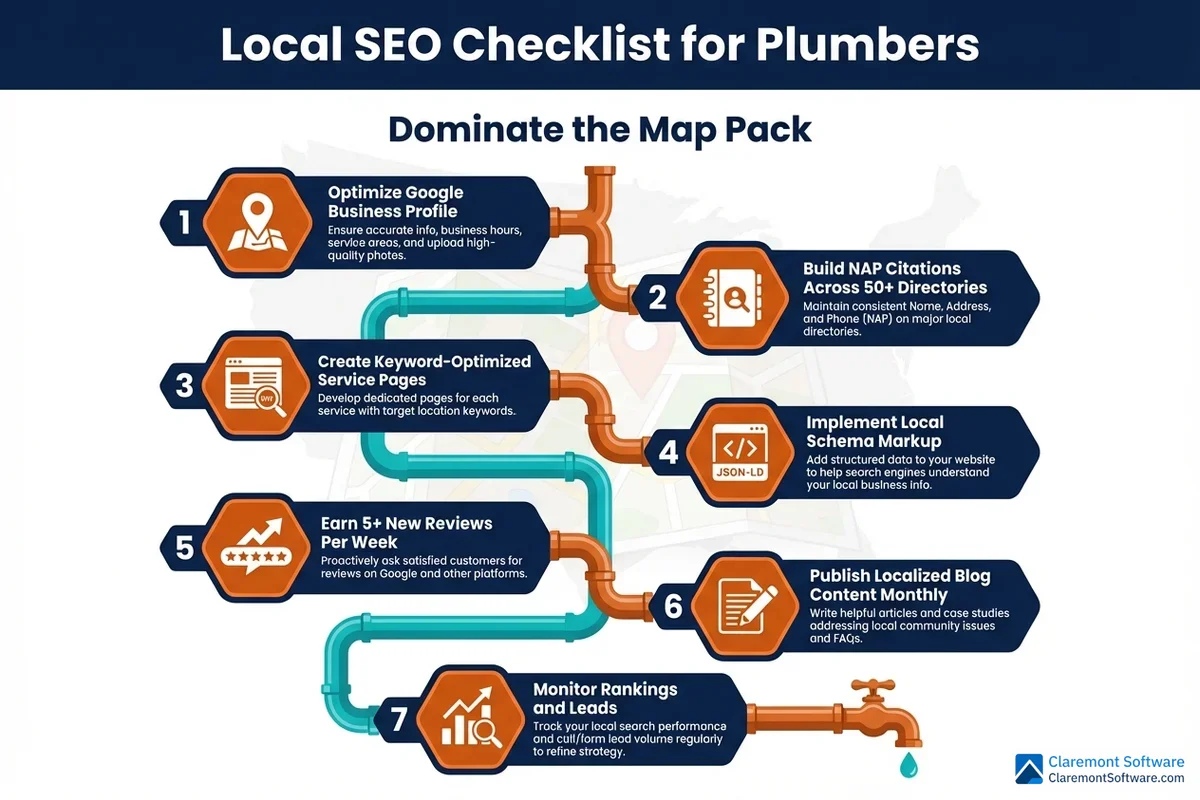
Your Google Business Profile (GBP) is the cornerstone of local SEO — and for most plumbers, it's the single most important piece of digital real estate you own. When someone searches for a plumber in your area, Google's Map Pack (the three local listings that appear above organic results) is often the first thing they see. Earning a spot there starts with a fully optimized GBP.
Here's what that looks like in practice:
- Choose the right primary category. "Plumber" is your primary category — don't get creative here. Google uses this to determine when to show your listing, and the wrong choice can tank your visibility.
- Add relevant secondary categories. Drain cleaning service, water heater installer, and sewer contractor are all legitimate secondary categories that expand the searches your profile appears for.
- List every service you offer. Google allows you to add individual services with descriptions and prices. Use this feature thoroughly — it signals relevance for specific searches like "tankless water heater installation" or "sewer line repair."
- Post weekly updates. Google Posts function like mini social media updates directly on your profile. Use them to share seasonal tips, promotions, or recent jobs. Consistent posting signals an active, credible business.
- Upload job photos regularly. Before-and-after photos of real work — a corroded pipe replaced, a water heater swapped out, a drain cleared — build trust and differentiate your listing from competitors with stock images.
- Manage your Q&A section proactively. Seed it with common questions ("Do you offer 24/7 emergency service?") and answer them yourself before customers ask.
- Generate and respond to reviews. Review quantity, recency, and your response rate all influence your Map Pack ranking. More on this in the reputation management section — but know that reviews are a local SEO signal, not just a trust signal.
On-Page SEO: Building Pages That Rank and Convert
Your website needs to earn its place in organic search results, and that requires deliberate on-page optimization. For plumbing companies, this means creating dedicated service-area pages for every city or neighborhood you serve. A single "Service Areas" page listing ten towns won't rank for "plumber in [specific city]" — but a fully developed page for each location, with unique content, local landmarks, and relevant service information, absolutely can.
Schema markup is another non-negotiable. Adding LocalBusiness and PlumbingService schema to your pages tells Google exactly what your business does, where it operates, and how to contact you. This structured data improves your chances of appearing in rich results and AI-generated answers.
Given that most emergency plumbing searches happen on smartphones, mobile-first optimization isn't optional — it's the baseline. Your site needs to load in under three seconds on a mobile connection, display cleanly on small screens, and make it effortless for someone in a panic to find your phone number and tap to call.
Technical SEO: The Foundation Beneath the Surface
Technical SEO is the infrastructure that allows everything else to work. For multi-service plumbing companies, site architecture matters enormously. Organize your site so that service categories (drain services, water heater services, emergency plumbing) sit logically beneath your homepage, with individual service pages nested within each category. This hierarchy helps Google understand your site's structure and distributes ranking authority efficiently.
Internal linking between related service pages reinforces topical relevance — your sewer line repair page should link to your drain cleaning page, and both should link to your service-area pages. Submit an XML sitemap through Google Search Console and audit your site regularly for crawl errors, broken links, and indexing issues that could silently suppress your rankings.
Link Building: Earning Authority in Your Community
Local link building is less about volume and more about relevance. A link from your city's chamber of commerce, a local supplier's vendor directory, or a community organization you sponsor carries far more weight than a generic directory listing. Prioritize:
- Local citations on platforms like Yelp, Angi, and the Better Business Bureau — consistent NAP (name, address, phone) data across all listings is essential
- Chamber of commerce and trade association memberships, which typically include a website listing
- Supplier and manufacturer partnerships, where being listed as a certified installer or preferred contractor earns you a credible backlink
- Community sponsorships — sponsoring a local youth sports team or charity event often results in a mention on the organization's website
Local SEO is a long game, but it's one that compounds. The plumbing companies investing in it consistently today are the ones dominating their markets — and defending that position — for years to come.
Google Ads and PPC: Capturing High-Intent Plumbing Leads Fast

When a homeowner's pipe bursts on a Sunday morning, they're not browsing — they're searching with their wallet already open. That urgency is exactly what makes pay-per-click advertising so valuable for plumbing businesses. 41% of clicks go to the top three paid ads on search results pages, and plumbing keywords sit among the highest-intent searches on the internet. Someone typing "emergency plumber near me" or "water heater replacement cost" isn't doing casual research — they're ready to call. PPC puts your business in front of that person before your competitors even have a chance.
Google Local Services Ads: The Pay-Per-Lead Game Changer
For most plumbing companies, Google Local Services Ads (LSAs) should be the first PPC investment on the table. Unlike traditional Google Ads where you pay per click, LSAs charge you only when a potential customer contacts you directly through the ad — making it a true pay-per-lead model.
The centerpiece of LSAs is the Google Guaranteed badge, a green checkmark that signals to homeowners that Google has verified your business license, insurance, and background checks. In a service industry built on trust, that badge carries real weight. Earning it requires submitting your credentials through Google's verification process, but the payoff is significant — LSAs with the Google Guaranteed badge consistently deliver some of the lowest cost-per-lead figures in plumber digital marketing, often ranging between $25 and $75 per verified lead depending on your market.
LSAs appear above everything else on the search results page — above traditional paid ads, above the Map Pack, above organic results. That prime real estate, combined with the pay-per-lead model, makes them an efficient starting point before layering in more complex campaign structures.
Google Search Campaigns: Structure That Converts
Once LSAs are running, traditional Google Ads search campaigns give you more control over messaging, targeting, and budget allocation. The key is organizing campaigns by service type rather than lumping everything together. A well-structured plumbing account might include separate campaigns for:
- Emergency services (burst pipes, flooding, gas leaks) — highest urgency, highest bids
- Drain cleaning and rooter services — high volume, competitive
- Water heater repair and replacement — strong ticket value, worth aggressive bidding
- Sewer line services — lower volume but high job value
This structure lets you control budgets and bids at the service level, write ad copy that speaks directly to each customer's specific problem, and track which services generate the best return.
Negative keywords are equally important. Without them, your emergency plumbing budget gets eaten by searches like "plumbing school near me" or "DIY pipe repair." Build a robust negative keyword list from day one and refine it continuously.
Your ad copy should lead with the customer's problem, not your company name. Headlines like "Burst Pipe? We're Available 24/7" or "Same-Day Water Heater Replacement" outperform generic branding every time. Include your service area, a clear call to action, and trust signals like years in business or a satisfaction guarantee.
Retargeting: Staying Visible After the First Visit
Not every visitor calls on the first click. Retargeting campaigns — display and search ads that follow users who visited your website without converting — keep your business visible while they compare options. For non-emergency services like water heater upgrades or bathroom repiping, homeowners often visit multiple sites before deciding. A well-timed retargeting ad can be the nudge that brings them back to you.
Retargeting also works well for seasonal promotions. Serving display ads to past website visitors before winter hits — promoting pipe insulation checks or water heater tune-ups — reaches an already-warm audience at exactly the right moment.
Budget Guidance: Starting Smart and Scaling Strategically
A solo plumber or small shop should expect to start with $1,500–$3,000 per month in combined LSA and search ad spend to generate meaningful lead volume in most markets. Mid-sized companies targeting multiple service lines or locations should budget $4,000–$8,000 monthly. Larger operations competing in major metros may need $10,000 or more to maintain competitive positioning.
To calculate your target cost-per-lead, work backward: if your average plumbing job is worth $450 and you close 40% of leads, you can afford to spend up to $180 per lead and still profit. If your campaigns are delivering leads below that threshold, that's your signal to scale spend — not pull back.
Website Design and Conversion Optimization for Plumbing Companies
Think about the last time you needed to hire someone for an urgent job. You probably pulled up their website within seconds of finding their name — and made a snap judgment about whether they seemed trustworthy before you ever read a single word. Your potential customers do exactly the same thing. 75% of people judge a company's credibility based on website design, which means your plumbing website isn't just a digital brochure — it's your hardest-working salesperson, closing deals (or losing them) around the clock.
The Anatomy of a High-Converting Plumber Website
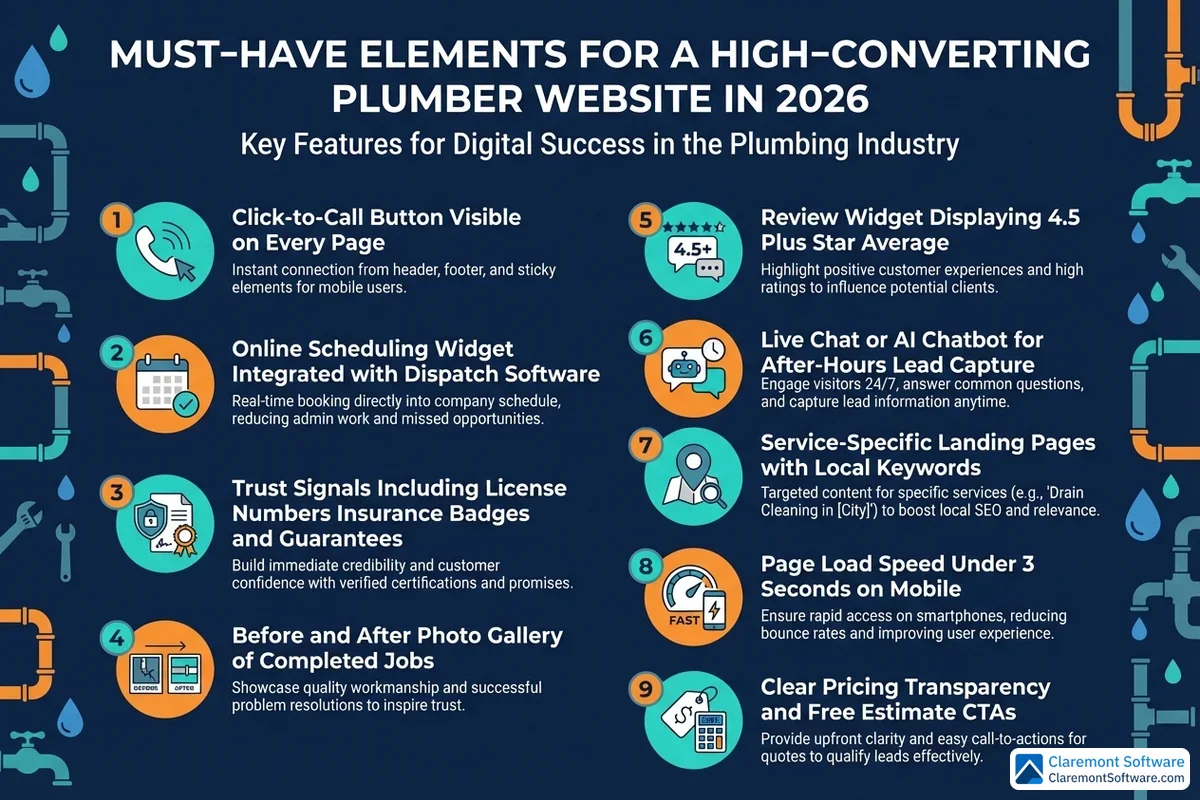
A beautiful website that doesn't generate calls is just an expensive art project. Every design decision should serve one goal: turning visitors into booked jobs. The essential elements that make that happen include:
- Click-to-call buttons placed prominently at the top of every page — not buried in the footer, not hidden in a contact form, but front and center where a panicked homeowner can tap it instantly
- Online scheduling tools that let non-emergency customers book appointments without picking up the phone — a growing segment of homeowners, particularly younger ones, strongly prefer this
- Trust badges displayed above the fold: state license numbers, proof of insurance, manufacturer certifications, and any satisfaction guarantees your company offers
- Before-and-after photo galleries showing real work from real jobs — these do more to build confidence than any marketing copy you could write
- Prominent review widgets pulling in your Google or third-party ratings so visitors see social proof the moment they land on your site
Mobile-First Is Non-Negotiable
Emergency plumbing searches don't happen at a desktop computer. They happen on a phone, often with one hand, while the other hand is holding a towel against a leaking pipe. Your website must be engineered for that reality. Pages should load in under three seconds on a mobile connection — every additional second of load time measurably increases bounce rates. Navigation should be thumb-friendly, with large tap targets and a logical flow that gets someone to your phone number in two taps or fewer. A sticky call button that remains visible as users scroll is one of the simplest, highest-impact conversion improvements any plumbing website can implement.
Conversion Rate Optimization: Squeezing More from Your Existing Traffic
Getting traffic to your site is only half the battle. Conversion rate optimization (CRO) is the discipline of turning more of that traffic into actual leads — without spending an extra dollar on advertising. Practical tactics include:
- A/B testing headlines and calls to action on your most-visited pages to identify which messaging resonates with your specific audience
- Adding live chat or an AI chatbot to capture after-hours visitors who won't call but will type a quick question — these tools can qualify leads and collect contact information automatically
- Creating dedicated landing pages for each service and each location you serve, rather than sending all traffic to a generic homepage
- Reducing form fields to the bare minimum — name, phone number, and a brief description of the problem is all you need to start a conversation
Closing the Loop: Integration with Field Service Management
Your website's job doesn't end when someone submits a form or books an appointment. The real efficiency gain comes from integrating your website with field service management software — platforms that connect scheduling, CRM, and dispatch into a single workflow. When a lead comes in through your website and flows automatically into your dispatch system without anyone manually re-entering data, you eliminate delays, reduce errors, and respond faster than competitors who are still copying phone numbers into spreadsheets. That speed-to-response advantage alone can meaningfully improve your close rate on inbound leads.
Online Reputation Management and Review Generation
Your plumbing skills might be what gets the job done, but your online reputation is what gets the phone ringing in the first place. 9 out of 10 people check online reviews before choosing a business, and consumers spend 31% more with companies that have excellent reviews. For plumbers, that's not a soft marketing metric — it's a direct line to revenue.
Building a Systematic Review Generation Process
The biggest mistake plumbing businesses make with reviews is treating them as something that happens organically. The companies with 200+ five-star ratings didn't get there by accident — they built a repeatable system.
The most effective approach combines timing with convenience. A post-job text message sent within an hour of completing the work — while the customer is still relieved and grateful — consistently outperforms any other review request method. Pair that with an automated follow-up email for customers who don't respond to the text, and you've created a two-touch sequence that runs without manual effort.
For technicians in the field, the ask matters too. Train your team to close every job with a simple, natural request: "If everything looked good today, we'd really appreciate a quick Google review — it helps our small business a lot." Most satisfied customers are happy to help; they just need the prompt. Adding a QR code directly to your invoice that links to your Google review page removes every possible friction point.
Managing Negative Reviews the Right Way
Negative reviews are inevitable — what separates top-rated plumbing companies is how they respond. Never ignore a critical review, and never respond defensively. A calm, professional reply that acknowledges the customer's concern and offers to make it right signals to every future reader that you stand behind your work.
For genuinely fake reviews or those suspected to be competitor-planted, document everything and use Google's review removal request process. While removal isn't guaranteed, flagging violations is always worth pursuing.
Monitoring Across Every Platform
Your reputation lives beyond Google. Homeowners are checking Yelp, Nextdoor, Angi, Thumbtack, and the Better Business Bureau before making their decision. Set up monitoring alerts for each platform so no new review — positive or negative — goes unnoticed for more than 24 hours.
Finally, don't underestimate the SEO impact of your review profile. Review velocity (how frequently you're earning new reviews) and recency (how recent your latest reviews are) are both active ranking signals in Google's local algorithm. A steady stream of fresh reviews doesn't just build trust with homeowners — it directly strengthens your position in the Map Pack and improves the quality scores that influence your ad performance.
Social Media Marketing for Plumbing Businesses

With 81% of U.S. adults active on at least one social media platform, ignoring social media isn't a neutral decision for your plumbing business — it's actively ceding ground to competitors who show up where your future customers are already spending time. But showing up everywhere without a strategy is just noise. The key is matching your content and effort to the platforms where your specific audience actually lives.
Platform-by-Platform Strategy
Each social platform serves a different purpose in your plumbing marketing mix:
- Facebook remains the workhorse for local service businesses. Its combination of community groups, business pages, and powerful advertising tools makes it the best platform for reaching homeowners in your service area. Facebook accounts for one in every six minutes spent online — your local audience is there, and they're reachable.
- YouTube is where you build long-term authority. How-to videos, explainer content, and job walkthroughs position your company as the trusted expert before a homeowner ever has an emergency. Videos also rank in Google search results, giving your content double the exposure.
- Instagram and TikTok thrive on visual storytelling. Before-and-after transformations, behind-the-scenes job footage, and quick plumbing tips perform exceptionally well in short-form video formats. These platforms skew younger but are increasingly where millennial homeowners — now the largest home-buying demographic — spend their time.
- LinkedIn is worth your attention if you pursue commercial plumbing contracts. Four out of five LinkedIn members drive business decisions, and its B2B audience carries twice the buying power of the average web audience. A well-maintained LinkedIn presence can open doors to property managers, general contractors, and facility directors that no residential ad campaign ever would.
Facebook Advertising for Plumbers
Organic social reach has declined significantly across most platforms, but Facebook's paid advertising tools remain remarkably precise for local service businesses. You can target homeowners specifically — filtering by zip code, age range, and homeownership status — to ensure your ads reach people who actually have pipes to fix. Retargeting campaigns that serve ads to people who visited your website but didn't call are particularly cost-effective, keeping your brand visible during the consideration window between their first search and their final decision.
Content That Actually Resonates
The plumbing businesses that build genuine social followings aren't posting stock photos of wrenches. The content that earns engagement includes:
- Seasonal maintenance tips (winterization reminders, spring checkup checklists)
- Day-in-the-life videos showing your team at work — these humanize your brand in a way no ad can replicate
- Myth-busting posts about common plumbing misconceptions ("No, you shouldn't pour grease down the drain even with hot water running")
- Team spotlights that introduce the faces behind the trucks
- Community involvement posts when you sponsor a local event or support a neighborhood cause
Posting Frequency and Content Batching
Consistency beats frequency. For most plumbing businesses, three to four Facebook posts per week, two to three Instagram posts, and one YouTube video per month is a sustainable and effective cadence. The practical secret to maintaining that consistency as a busy business owner is batching: set aside two to three hours once a month to plan, film, and schedule a full month of content in one sitting. A simple smartphone, good natural lighting, and a genuine willingness to show your work is all the production equipment you actually need.
Email and SMS Marketing: Turning One-Time Calls into Lifetime Customers
Most plumbing businesses focus their marketing dollars on getting the first call. The smarter play is building a system that turns that first call into a decade of repeat business — and email and SMS marketing are the most cost-effective tools for doing exactly that. For every $1 spent on email marketing, the average return is $44, making it one of the highest-ROI channels available to plumbing companies, particularly for customer retention.
Email Campaign Types That Work for Plumbers
The most effective plumber email campaigns are built around the natural rhythms of homeownership:
- Seasonal maintenance reminders — Send winterization tips and service offers in October before the first freeze, and spring checkup promotions in March before the busy season hits. Customers who hear from you proactively are far more likely to call you reactively when something breaks.
- Post-service follow-ups — A simple "thank you for choosing us" email sent within 24 hours of a completed job reinforces trust, invites a review, and plants the seed for your referral program.
- Referral program promotions — Your happiest customers are your best salespeople. A well-timed email offering a discount or gift card for referrals can generate high-quality leads at a fraction of what paid ads cost.
- New service announcements — Adding tankless water heater installations or whole-house repiping? Your existing customer list is the warmest audience you have.
SMS Marketing: The High-Open-Rate Channel
Text messaging earns open rates that email simply can't match — most texts are read within minutes of delivery. For plumbers, the highest-value SMS use cases include appointment confirmations and reminders (which dramatically reduce no-shows), post-job review requests, and flash promotions during slow periods to fill gaps in the schedule. During weather emergencies — a hard freeze, a major storm — a timely text alerting your customer base to your emergency availability can generate a surge of inbound calls within hours.
Building and Segmenting Your List
A generic blast to your entire contact list underperforms every time. Segment your list by residential versus commercial customers, service history (water heater customers vs. drain cleaning customers), and geographic zone if you serve multiple areas. This lets you send the right message to the right customer at the right moment rather than blasting everyone with offers that don't apply to them.
Automation: The Force Multiplier
Marketing automation is where email and SMS go from good to exceptional. Set up drip sequences for leads who inquired but didn't book — a three-email sequence over two weeks can recover a meaningful percentage of those lost opportunities. Build annual maintenance reminder workflows that trigger automatically based on a customer's last service date. And create re-engagement campaigns for customers who haven't called in 18 months or more, reminding them you're still their neighborhood plumber. Once these workflows are built, they run in the background generating revenue without requiring your daily attention.
Content Marketing and Blogging Strategy for Plumbers
With 63% of consumers primarily using a company's website to find and engage with them, your website isn't just a digital business card — it's the hub of your entire content ecosystem. Content marketing builds the topical authority and keyword relevance that search engines reward with organic rankings, and it does so in a way that compounds over time. A blog post you publish today can generate leads for years without any additional spend.
Blog Topics That Attract the Right Traffic
The most effective plumbing blog strategy targets long-tail keywords — the specific, conversational phrases homeowners type when they have a problem and need answers. Think "why is my water heater making a popping noise," "how to shut off water to my house in an emergency," or "signs you need a sewer line replacement." These searches signal real intent from real homeowners in your service area. They may not generate massive traffic volume individually, but the visitors they attract are already halfway to picking up the phone. Aim to answer the questions your technicians hear most often in the field — that's your content roadmap.
Service Pages: The Foundation of Organic Lead Generation
Blog content drives awareness, but dedicated service pages close the deal. Every service you offer — drain cleaning, water heater installation, sewer line repair, tankless water heater upgrades, emergency plumbing — deserves its own fully developed page with unique descriptions, local keyword variations, and clear calls to action. A single generic "services" page leaves significant organic traffic on the table. Build each page as if it's the only page a potential customer will ever see, because for many of them, it will be.
Video Content: The Engagement Multiplier
Written content and video work best together. YouTube how-to tutorials build long-term brand authority and rank in Google search results independently of your website. Short-form videos repurposed from those tutorials perform well on social platforms. Embedding video directly on your service pages increases time-on-site — a signal search engines interpret as a quality indicator — and gives hesitant visitors the reassurance they need to convert.
Content Calendar and Measuring What Works
A sustainable rhythm of two to four blog posts per month is enough to build meaningful organic traction without overwhelming a busy plumbing operation. Batch your content creation, repurpose each post into social snippets and email content, and track performance through lead attribution in your CRM. The goal isn't traffic for its own sake — it's booked jobs you can trace back to a specific piece of content.
AI-Powered Marketing Tools and Emerging Trends for 2026

The way plumbers get found online is shifting faster in 2026 than at any point in the past decade. AI-powered search, voice queries, and tightening privacy regulations aren't distant trends — they're reshaping how homeowners discover and contact plumbing businesses right now. Understanding these changes isn't optional; it's the difference between staying visible and getting buried.
AI Search and Zero-Click Visibility
Google's AI Overviews (formerly Search Generative Experience) now answer many plumbing questions directly on the search results page — without the user ever clicking through to a website. When someone searches "why is my water pressure low," Google may serve an AI-generated answer before any organic results appear. To stay visible in this environment, your content needs to be structured as the source AI pulls from: clear, authoritative answers to specific questions, proper schema markup, and content that directly addresses the queries your customers are actually typing. Optimizing for featured snippets and structured data isn't just good SEO practice anymore — it's your ticket into AI-generated answers.
AI Chatbots: Capturing After-Hours Emergency Leads
Plumbing emergencies don't follow business hours. An AI-powered chatbot on your website can engage a panicked homeowner at 11 PM, collect their contact information, qualify the urgency of their situation, and either connect them to an on-call technician or schedule a morning appointment — all without any human involvement. This kind of 24/7 conversational marketing captures leads that would otherwise bounce to a competitor who happened to answer. Modern chatbot tools are increasingly affordable and integrate directly with scheduling and CRM platforms.
AI-Powered Ad Optimization
Machine learning has fundamentally changed how paid advertising works. Smart bidding algorithms now adjust bids in real time based on hundreds of signals — device type, time of day, search history, location — far beyond what manual management can replicate. For plumbers running Google Ads, leaning into automated bidding strategies like Target CPA or Maximize Conversions, combined with responsive search ads that test multiple headlines simultaneously, typically outperforms manually managed campaigns once sufficient conversion data is in place.
Voice Search Optimization
Voice queries are conversational and hyper-local: "Hey Google, find a plumber near me open right now" is structurally different from typing "plumber Chicago." Optimizing for voice means incorporating natural-language phrases into your content, ensuring your Google Business Profile hours are accurate, and building FAQ-style content that mirrors how people actually speak their questions aloud.
Privacy Changes and First-Party Data
Third-party cookies are effectively gone in 2026, and with them, a significant portion of traditional retargeting infrastructure. Plumbers who relied on cookie-based audience targeting need to pivot toward first-party data strategies: building email and SMS lists, using server-side tracking to maintain conversion visibility, and leveraging contextual advertising that targets content relevance rather than individual browsing history. The plumbers who invested in owned customer data — email lists, CRM records, service histories — are now sitting on a significant competitive advantage.
Plumber Marketing Budgets: How Much to Spend by Company Size
Knowing that you need to invest in digital marketing is one thing. Knowing how much to invest — and where to put every dollar — is where most plumbing business owners get stuck. Spend too little and you're invisible. Spend without a plan and you're burning cash on channels that don't convert. The good news: there's a reliable framework for getting this right, regardless of where your business stands today.
The General Rule of Thumb
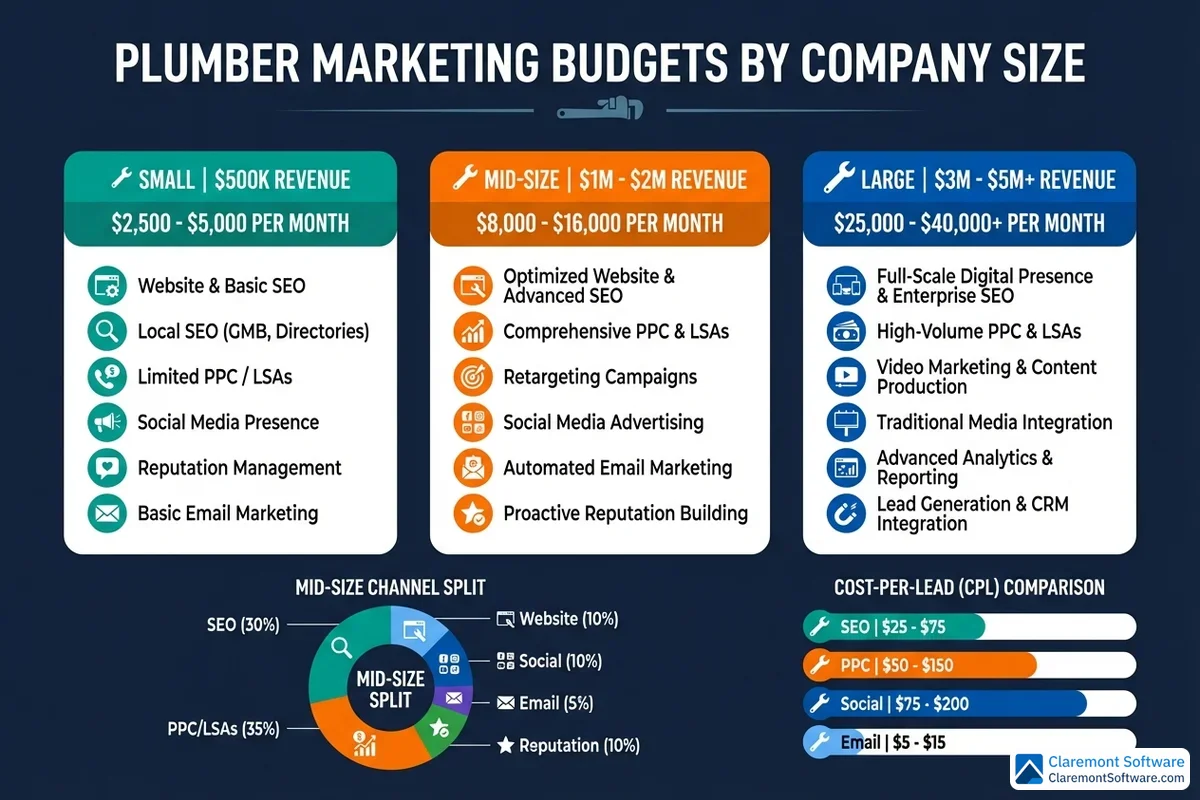
Most established plumbing companies should invest 5–10% of gross revenue in marketing. If you're a newer operation still building your customer base, or you're in aggressive growth mode — expanding into new service areas, adding crews, or going after commercial contracts — budget closer to 10–15%. These aren't arbitrary numbers. They reflect what it actually costs to maintain visibility in competitive local markets while generating enough lead volume to keep your trucks running at capacity.
Budget Breakdown by Company Size
Here's how those percentages translate into real monthly spend:
- $500K annual revenue: $2,500–$5,000/month. At this stage, prioritize Google Business Profile optimization, local SEO, and Google Local Services Ads. These three channels alone can generate consistent lead flow without overextending a lean budget.
- $2M annual revenue: $10,000–$16,000/month. You now have the budget to run multi-channel campaigns — combining SEO, PPC, social media ads, email marketing, and a professionally managed reputation strategy.
- $5M+ multi-location operation: $25,000–$40,000+/month. At this scale, you're investing in market dominance: aggressive paid search, content marketing programs, video production, and potentially dedicated marketing staff or a full-service agency relationship.
Channel Allocation by Growth Stage
How you split your budget matters as much as the total. A reasonable starting allocation for a growth-stage plumbing company might look like this: 35–40% to PPC and LSAs (for immediate lead volume), 25–30% to SEO (for compounding long-term returns), 10–15% to website development and CRO, and the remainder split across social media, email, and reputation management tools.
ROI Benchmarks by Channel
Understanding your expected cost-per-lead by channel helps you allocate intelligently:
- SEO: $25–$75 per lead (lower cost, but takes 3–6 months to build momentum)
- Google Ads and LSAs: $50–$150 per lead (immediate results, higher cost)
- Social media ads: $75–$200 per lead (best for brand awareness and retargeting)
- Email marketing: $5–$15 per lead (the most cost-efficient channel for existing customers)
When to Increase Your Spend
Watch for these signals that it's time to scale your marketing investment: your technicians are consistently booked out more than a week, you're turning away jobs due to capacity constraints you're actively working to resolve, you're entering a new service area, launching a new service line, or a well-funded competitor has moved into your market. In each of these scenarios, pulling back on marketing spend is the wrong instinct — it's precisely when strategic investment pays the highest return.
Seasonal Marketing Strategies for Plumbing Businesses
Plumbing demand doesn't flow at a steady rate year-round — it surges, dips, and spikes in patterns that are remarkably predictable once you know what to look for. The plumbers who align their marketing spend and messaging with these seasonal rhythms consistently outperform competitors who run the same campaigns on autopilot all year long.
Map Your Calendar to Demand Cycles
Each season brings its own dominant service calls:
- Winter: Frozen pipes, burst lines, and water heater failures dominate. Cold snaps create genuine emergencies, and homeowners need help fast.
- Spring: Sewer line issues surface as ground thaws and tree roots become active. Homeowners also shift into maintenance mode, making this prime time for checkup promotions.
- Summer: Sprinkler system work, bathroom remodels, and whole-house projects pick up as homeowners tackle bigger jobs during warmer months.
- Fall: Winterization services, water heater inspections, and furnace-related plumbing prep drive demand as temperatures begin to drop.
Understanding this cycle lets you get ahead of demand rather than simply reacting to it.
Adjust PPC Budgets Before the Rush Hits
The biggest mistake plumbers make with paid advertising is waiting until demand peaks to increase their budgets. By then, competition for keywords is at its highest and costs-per-click spike. Instead, increase your PPC spend 2–3 weeks before each seasonal peak — before your competitors do. During active weather events, switch to urgency-driven ad copy: "Frozen pipe? We're available now" outperforms generic messaging when a homeowner is in crisis mode.
Seasonal Content and Email Timing
Publish seasonal blog posts and send maintenance reminder emails 2–4 weeks before each season's peak demand. A "Fall Plumbing Checklist" email sent in late September positions you as a trusted advisor and generates booked appointments before your competitors are even thinking about it. Timely content also captures organic search traffic from homeowners who are just beginning to think about seasonal maintenance.
Turn Slow Periods Into Revenue Opportunities
Slower months aren't dead months — they're your window to promote higher-ticket, non-urgent services. Water heater upgrades, whole-house repiping, bathroom remodels, and water filtration installations don't require an emergency trigger. Run targeted promotions and email campaigns during your historically slower periods to smooth out revenue fluctuations and keep crews productive.
Build Your Emergency Marketing Playbook Now
Weather emergencies move fast. Have pre-built ad campaigns, social media posts, and email templates ready to activate the moment a cold snap or flooding event hits your service area. A plumber who can launch a targeted "burst pipe emergency" campaign within an hour of a freeze warning will capture a disproportionate share of those high-intent, high-urgency leads — while competitors scramble to put something together from scratch.
Hiring a Plumbing Marketing Agency vs. DIY: How to Decide
At some point, every growing plumbing business faces the same crossroads: keep handling marketing in-house, or hand it off to professionals? The honest answer is that neither option is universally right — the best choice depends on where your business is today, how fast you want to grow, and how much complexity you're willing to manage yourself.
When DIY Makes Sense
If you're a solo plumber or running a small shop under $500K in annual revenue, handling your own marketing fundamentals is not only feasible — it's often the smartest move. You don't need an agency to claim and optimize your Google Business Profile, respond to reviews, post on social media a few times a week, or send a seasonal email to your customer list.
The threshold is time. If you can realistically dedicate 5–10 hours per week to marketing tasks, you can build a solid local presence without outside help. Start with the highest-impact basics: a fully optimized Google Business Profile, a steady stream of new reviews, and a mobile-friendly website with a clear call-to-action. These three fundamentals alone will outperform most competitors who are doing nothing at all.
When to Hire an Agency
Once your marketing spend crosses $3,000 per month, the complexity of managing multiple channels — paid search, SEO, content, social ads, tracking, and reporting — typically exceeds what a busy plumbing business owner can handle effectively on the side. At that investment level, mismanaged campaigns don't just underperform; they actively waste money.
Other clear signals that it's time to bring in professional help:
- You're expanding into new service areas and need to build visibility quickly
- You're running Google Ads but have no idea whether they're actually profitable
- Your competitors are consistently outranking you and you don't know why
- You want to add channels like video marketing or advanced retargeting but lack the expertise
A qualified plumbing marketing agency brings channel expertise, industry benchmarks, and dedicated bandwidth that most in-house operators simply can't match.
Red Flags to Watch For
Not all agencies are worth your money. Before signing anything, watch for these warning signs:
- Long-term contracts with no performance guarantees — reputable agencies stand behind their results
- Lack of transparent reporting — if you can't see exactly where your money is going and what it's producing, that's a problem
- They own your ad accounts, website, or data — you should always retain ownership of your digital assets, full stop
- No plumbing industry experience — a generalist agency learning your industry on your dime is a costly experiment
Questions to Ask Before You Sign
Vet every agency with these non-negotiable questions: What plumbing clients have you worked with, and can I speak to them directly? Can you show me verified case studies with real lead and revenue numbers? Do I own my website, ad accounts, and all associated data if we part ways? What does your monthly reporting look like, and what metrics do you track beyond raw lead volume?
The answers will tell you everything you need to know.
The Hybrid Approach
For many mid-sized plumbing companies, the smartest path is a hybrid model: manage high-touch, relationship-driven channels in-house — social media, review responses, customer communications — while outsourcing the technical heavy lifting to specialists. SEO, PPC campaign management, and website development all require deep expertise and ongoing optimization that genuinely benefits from professional management. Splitting responsibilities this way keeps costs manageable while ensuring your most complex channels are handled by people who do this every day.
Tracking ROI and Measuring Marketing Performance
Most plumbing businesses track leads. Far fewer track what actually matters: booked jobs, completed revenue, and the true return on every marketing dollar spent. That gap — between leads counted and revenue attributed — is where marketing budgets quietly hemorrhage money. Closing it requires building a tracking infrastructure that follows a customer from their first click all the way to a paid invoice.
Stop Counting Leads, Start Counting Revenue
A lead that never books is worth nothing. Yet most plumbers evaluate their marketing performance by lead volume alone, which creates a dangerously incomplete picture. A channel generating 50 cheap leads with a 10% booking rate is outperformed by one generating 20 higher-quality leads that convert at 60%. Attribution modeling — connecting specific marketing channels to actual booked and completed jobs — is what separates plumbers who scale profitably from those who spend more and wonder why growth stalls.
Essential Tracking Tools
Building a reliable tracking stack doesn't require enterprise-level complexity. Start with these core tools:
- Call tracking with dynamic number insertion (DNI): Tools like CallRail assign unique phone numbers to each marketing channel, so you know whether a call came from your Google Ads campaign, your organic search ranking, or your Facebook ad — without asking every caller how they found you.
- Form submission tracking: Every contact form, quote request, and scheduling widget on your website should fire a conversion event in Google Analytics and your ad platforms.
- CRM integration: Your customer relationship management system should capture the lead source and connect it to job status — quoted, booked, completed, and invoiced.
- Analytics dashboards: Consolidate data from Google Analytics, Google Search Console, your ad platforms, and your CRM into a single reporting view so you're not toggling between five different tabs to understand performance.
Key Metrics Every Plumber Should Monitor
Track these numbers consistently, broken down by channel:
- Cost per lead (CPL): Total channel spend divided by leads generated
- Cost per booked job: Total spend divided by jobs that actually made it onto the schedule
- Customer acquisition cost (CAC): Total marketing spend divided by new customers won
- Customer lifetime value (CLV): Average revenue per customer across all jobs over their relationship with your business
- Marketing ROI by channel: Revenue attributed to each channel minus its cost, expressed as a return multiple
Closing the Loop with Field Service Software
Integrating your marketing platforms with field service management software — such as ServiceTitan or similar tools — is what transforms tracking from theoretical to operational. When a lead comes in through a Google Ad, gets booked through your CRM, and is marked as a completed job in your dispatch software, you have a complete revenue attribution chain. That data tells you, with precision, which campaigns are generating profitable work and which are generating noise.
Reporting Cadence and Decision-Making
Review your core metrics monthly to catch underperforming campaigns before they drain significant budget. Conduct a deeper quarterly analysis to evaluate channel mix, adjust budget allocations, and identify seasonal patterns in your data. The goal isn't reporting for its own sake — it's making faster, more confident decisions about where to invest next.
Conclusion
The plumbers who will dominate their local markets in 2026 and beyond aren't the ones with the biggest trucks or the longest track record — they're the ones who show up first, look credible instantly, and follow up relentlessly. That's what a well-executed digital marketing strategy delivers.
No single channel wins alone. Local SEO builds the foundation. PPC captures urgent demand. A conversion-optimized website turns visitors into booked jobs. Reputation management earns trust before you ever answer the phone. Email and content marketing compound your returns over time. Together, these channels create a lead generation engine that works around the clock — even when your team is already booked solid.
Start where you are. Audit your Google Business Profile, shore up your review generation process, and make sure your tracking connects clicks to completed jobs. Then build from there, channel by channel, dollar by dollar.
The opportunity is real, the playbook is clear, and your competitors aren't standing still. Neither should you. If you're ready to accelerate the process, the team at Claremont Software is here to help you build a strategy that actually moves the needle.
Related Reading
- Plumber Advertising: What Works in 2026
- Plumber Lead Generation: 12 Strategies That Book Jobs
- Google Business Profile for Plumbers: Complete Guide
Frequently Asked Questions
How much should a plumbing company spend on digital marketing?
A general rule of thumb is to invest 5–10% of gross revenue in digital marketing. For a plumbing company generating $500K annually, that means roughly $2,500–$5,000 per month. A $2M company should budget $10,000–$16,000/month, while a $5M+ multi-location operation may invest $25,000–$40,000+ per month. Newer companies or those in aggressive growth mode should lean toward the higher end — 10–15% of revenue — to build market share faster. The key is not just how much you spend, but how well you track ROI from every dollar, connecting marketing spend directly to booked jobs and revenue.
What is the best digital marketing channel for plumbers — SEO or PPC?
Both channels serve different purposes, and the most successful plumbing businesses use them together. SEO is a long-term investment that builds compounding organic visibility for high-intent searches like 'water heater repair near me' — it typically delivers a lower cost-per-lead ($25–$75) once established. PPC, including Google Local Services Ads, generates leads immediately and is ideal for new businesses or filling capacity gaps fast, though at a higher cost-per-lead ($50–$150). If budget is limited, start with Google Local Services Ads for quick wins while building your SEO foundation in parallel. Over time, SEO becomes your highest-ROI channel.
How long does it take for plumber SEO to start generating leads?
Plumber SEO is not an overnight solution — most businesses begin seeing meaningful results within 3–6 months, with significant lead flow typically developing between 6–12 months. The timeline depends on factors like your local competition, the current state of your website, how aggressively you build content and backlinks, and whether your Google Business Profile is fully optimized. Highly competitive markets (major metro areas) may take longer. The payoff, however, is substantial: once your rankings are established, SEO delivers a steady stream of high-intent leads at a fraction of the cost of paid advertising, making the wait well worth the investment.
Are Google Local Services Ads worth it for plumbers?
Yes — Google Local Services Ads (LSAs) are widely considered one of the best advertising investments for plumbing companies. Unlike traditional Google Ads where you pay per click, LSAs operate on a pay-per-lead model, meaning you only pay when a potential customer actually contacts you. Earning the Google Guaranteed badge through LSAs also builds instant trust with homeowners. For plumbers, LSAs frequently deliver the lowest cost-per-lead of any paid channel, often ranging from $50–$150 per lead depending on your market. They appear at the very top of search results, above both standard paid ads and organic listings, capturing the highest-intent searchers at the moment they need help.
How can a small plumbing business compete with larger companies online?
Small plumbing businesses can absolutely compete online by focusing on hyper-local strategies that larger companies often overlook. Start by fully optimizing your Google Business Profile with accurate categories, service listings, photos, and a consistent stream of fresh reviews — this is the single highest-impact free tool available. Target neighborhood-level and long-tail keywords (e.g., 'emergency plumber in [specific suburb]') rather than broad terms dominated by big players. Build a fast, mobile-friendly website with clear calls to action. Invest in review generation, since 9 out of 10 consumers check reviews before choosing a plumber — a small business with 200 five-star reviews will consistently outperform a larger competitor with fewer or lower-rated reviews.
What should I look for when hiring a plumbing marketing agency?
When evaluating a plumbing marketing agency, look for proven experience specifically in the home services or plumbing industry — generic marketing agencies often lack the niche knowledge needed to compete in local plumbing markets. Ask to see verified case studies with real lead and revenue results. Ensure you will own your website, ad accounts, and all data — never sign with an agency that retains ownership of your assets. Watch for red flags like long-term contracts with no performance guarantees and a lack of transparent reporting. A trustworthy agency will provide clear monthly reporting that connects marketing spend to booked jobs, not just vanity metrics like impressions or clicks.
How do I get more Google reviews for my plumbing business?
The most effective way to generate more Google reviews is to build a systematic, repeatable process rather than relying on customers to leave reviews on their own. Send an automated text or email immediately after a job is completed with a direct link to your Google review page — timing is critical, as satisfaction is highest right after service. Train your technicians to verbally ask satisfied customers for a review before leaving the job site. Add a QR code linking to your review page on invoices, receipts, and business cards. Respond to every review — positive and negative — to show you value feedback. Consistent review velocity and recency also directly improve your local SEO rankings.
What is a good cost-per-lead for plumbing digital marketing?
Cost-per-lead benchmarks vary by channel and market competitiveness. As a general guide, SEO-generated leads typically cost $25–$75 once your rankings are established, making it the most cost-efficient channel long-term. Google Ads and Local Services Ads usually range from $50–$150 per lead, depending on your market and targeting. Social media advertising tends to run $75–$200 per lead for plumbing services. Email marketing is the most cost-effective retention channel, with leads costing as little as $5–$15. Keep in mind that cost-per-lead alone is not the full picture — always track cost-per-booked-job and customer lifetime value to understand the true ROI of each marketing channel.